

Eadie Law focuses on handling cases involving residents’ falls (broken bones/brain bleeds) in nursing homes.
Unfortunately, falls are common among older people, posing significant risks to their health and well-being. It’s important to recognize that many of these falls are preventable by implementing proper measures like sufficient funding for staffing.
By investing in well-trained and adequately staffed facilities, nursing homes can provide the necessary care and supervision to ensure the safety and well-being of their residents, ultimately preventing unnecessary falls and the potential consequences they entail.
Consultations For Nursing Home Issues
Years of
Experience
Recovered
For Clients
Years of Recognition on Super Lawyers
Superb Rating
on Avvo


Our fulfillment as attorneys comes not only from the successful outcomes we secure for our clients but also from knowing that we are part of a larger movement toward accountability and improved care in nursing homes.















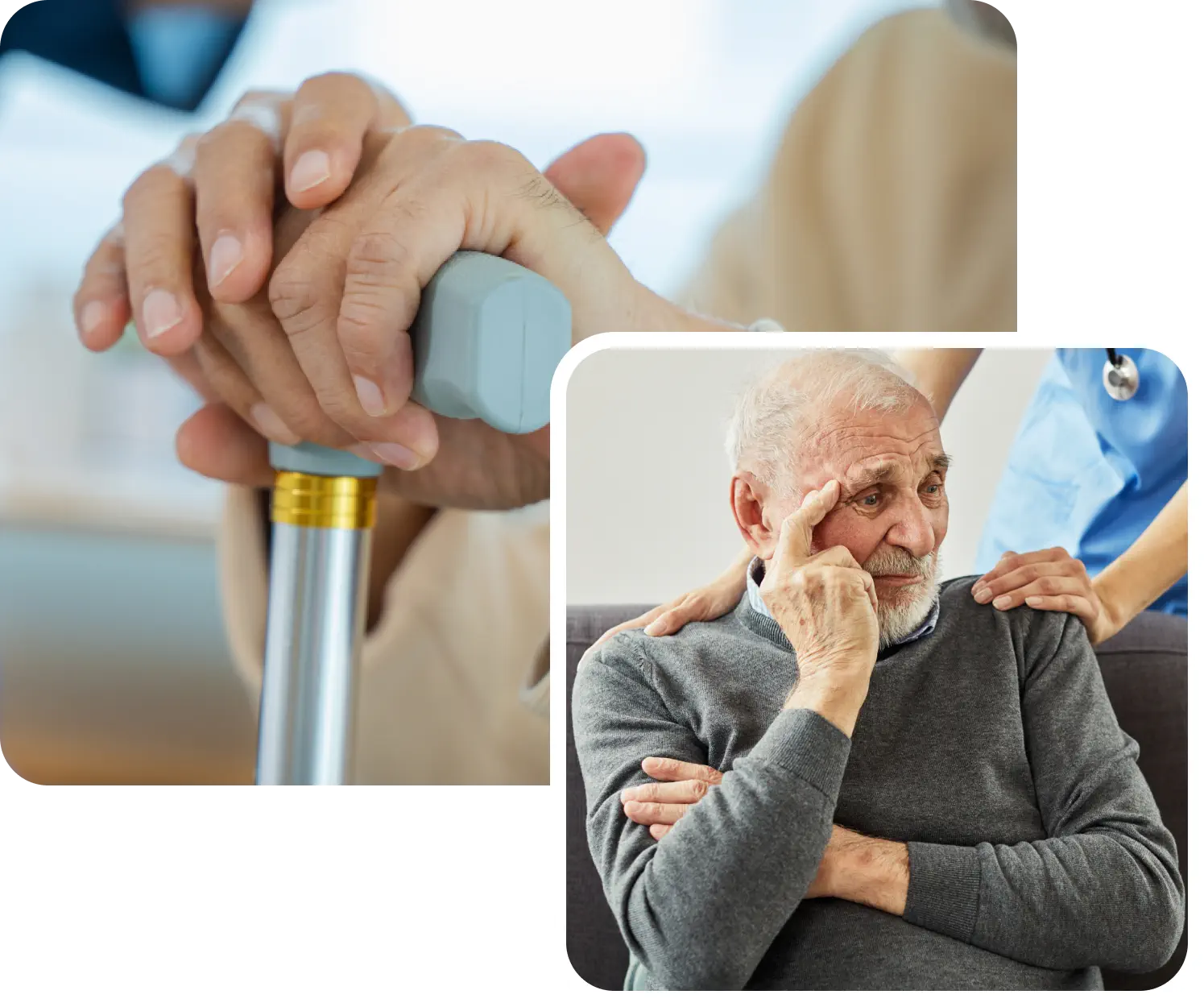
According to the Centers for Disease Control and Prevention (CDC), about 1,800 seniors living in nursing homes die each year from fall-related injuries.
Those who survive falls often sustain broken hips or injuries that cause permanent disability.
Twenty percent of fall-related deaths in the 65+ older age group occur in nursing homes.

The most common causes of falls in nursing homes as per the CDC are:
Preventing nursing home falls involves organizational, staff, and patient interventions.
First, families often focus solely on the patient level. The nursing home should provide appropriate care to its residents to prevent falls.
If caregivers for your parent or parents lack the knowledge, skills, or time to implement appropriate interventions, the effectiveness of well-intentioned interventions is compromised.
Educating and training nursing home staff to understand fall risk factors and prevention strategies to protect all their residents better.
Enhancing the nursing home environment with safety aids like grab bars, raised toilet seats, lower-height beds, and hallway handrails.
Assessing prescription medications for the potential risks of falling, and ensuring minimal use to accomplish the medical goals.
Assessing resident fall risk thoroughly at admission and on an ongoing basis to ensure optimal safety for new and existing residents.
Tools like bed and wheelchair alarms, floor mats, two-person assistance with transfers and bed mobility, and non-slip footwear are essential for safety.
Implement nursing home resident exercise programs to improve balance, strength, walking ability, and physical functioning.
If a resident sustains serious injuries from a fall in a nursing home, the facility may be accountable for:

With a personalized approach to each case, our team offers guidance and support beyond legal advice.
Analysis to understand the extent and cause of injuries
Open dialogue to address your fears and concerns
Improving safety standards across all of Ohio
In Ohio, you may bring a claim when a preventable fall was caused by negligent care or violations of resident rights. Federal quality-of-care rules require adequate supervision and assistive devices to avoid accidents (42 CFR §483.25), and Ohio’s Residents’ Bill of Rights guarantees a safe environment and dignity, among other rights (ORC §3721.13).
To answer “Can I sue an Ohio nursing home if my loved one fell and was injured or died?” look for evidence that required assessments and precautions were missed. Helpful proof includes:
When these records show avoidable risk and harm, a civil claim may be warranted. The best nursing home injury law firms work with nursing home experts to evaluate and (if the case goes to trial) testify to violations of the standard of care in a fall injury lawsuit. These experts can include Directors of Nursing, Licensed Nursing Home Administrators, Medical Directors and Physicians, Therapists, and other specialists.
When it comes to what legal standards require Ohio nursing homes to prevent falls, nursing homes must meet the standards set forth in federal regulations, Ohio administrative codes, the Ohio Resident Right’s law, and industry standards. These standards of care require Ohio nursing homes to provide care and services to prevent avoidable accidents through supervision, equipment, and individualized interventions under 42 CFR §483.25(d) (F689). They must also provide a safe environment. Ohio law further protects residents’ health, safety, and dignity under ORC §3721.13 and authorizes remedies for violations under ORC §3721.17.
When families ask, “What legal standards require Ohio nursing homes to prevent falls?” the answer includes concrete duties:
Failure to meet these standards can support liability for fall injuries in nursing homes.
When we’re asked by nursing home injury clients, “do I have a case against the nursing home after a fall injury or death?” We have to look at what the nursing home did before and after the fall, as nursing homes can be liable for failing to address fall risks, or for how they respond to a resident fall (or both), even beyond directly causing a fall (like dropping or abandoning a resident).
You may have a case against the nursing home after a fall injury if the facility failed to assess risk, ignored care-plan interventions, provided inadequate supervision or equipment, or allowed an unsafe environment, and that failure caused harm. Federal rules require preventing avoidable accidents (42 CFR §483.25), while ORC §3721.13 protects resident safety and dignity.
When you ask, “Do I have a case against the nursing home after a fall injury or death?” consider these indicators:
These facts, tied to standards, help establish negligence and causation under Ohio law.
In Ohio, the statute of limitations for an Ohio nursing home fall lawsuit depends on whether the claim is a “medical claim.” Most ordinary negligence claims must be filed within two years of the injury (ORC §2305.10). If the claim qualifies as a “medical claim,” it may be subject to a one-year limit from discovery or termination of the physician-patient relationship, with a potential 180-day extension after notice (ORC §2305.113). Because determining whether a fall injury is a medical claim or not involves legal analysis, contacting an Ohio nursing home injury lawyer early can be very important.
When families ask, “What is the statute of limitations for an Ohio nursing home fall lawsuit?” Timing matters.
Wrongful death arising from a nursing home fall generally carries a two-year limit from the date of death (ORC §2125.02). But note that the person’s pain and suffering claim still needs to be filed by the negligence deadline, or it will be lost. Acting promptly protects rights and preserves critical evidence.
Whether a nursing home fall injury lawsuit is a medical malpractice case (“medical claim”) or ordinary negligence in Ohio depends on whether the alleged negligence arises from medical diagnosis, care, or treatment versus custodial safety.
Medical claims often require an affidavit of merit under Civ.R. 10(D)(2) and may face the one-year statute (ORC §2305.113).
When you ask, “Is a nursing home fall a medical malpractice case or ordinary negligence in Ohio?” consider the conduct at issue: medication management and restraints suggest medical claims; unsafe premises, supervision, or equipment may indicate ordinary negligence with a two-year limit (ORC §2305.10). Proper classification guides deadlines and proof. Because this involves legal analysis, it is always safer to rely on a qualified Ohio nursing home injury lawyer to determine which type of claim (and therefore, your deadline to file the claims).
Recoverable damages in nursing home fall injury cases can include medical expenses, rehabilitation, pain and suffering, and, when applicable, loss of independence or permanent impairment. The goal is to make the resident whole within Ohio’s tort framework, including their economic and non-economic harms. However, non-economic harms are arbitrarily limited by Ohio damage caps.
When families ask, “What compensation is available for fall injuries in nursing homes?” note that non-economic damages may be capped in certain actions (ORC §2315.18 and, for medical claims, ORC §2323.43). Punitive damages require heightened proof and are limited by ORC §2315.21. Thorough documentation maximizes lawful recovery.
Wrongful death damages from a fatal nursing home fall lawsuit are not capped under Ohio law. These are the damages suffered by next of kin for their loss (including grief and mental anguish, loss of relationship, loss of advice, and more).
Ohio law allows statutory beneficiaries to recover for losses like companionship, guidance, and support under ORC §2125.02, with court-approved allocation under ORC §2125.03. Damages under these “wrongful death cases” are not capped under Ohio law.
When families ask, “What compensation is available in an Ohio nursing home fall death?” The answer involves proving negligence and damages, then navigating probate for fair distribution. Documentation of relationships, support, and grief helps the court equitably divide recovery among beneficiaries.
The injured resident or a legal guardian may file personal injury or resident-rights claims. For a nursing home fall death, the personal representative files a wrongful death action on behalf of statutory beneficiaries (ORC §2125.02) through the estate.
When you ask, “Who can file a lawsuit after a nursing home fall injury or death in Ohio?” understand that recovery is later apportioned by the probate court under ORC §2125.03. Establishing the estate and representative early helps preserve claims and evidence. The estate representative has a fiduciary duty to the other potential beneficiaries.
We see this all the time.
Federal standards require Ohio nursing homes to provide every resident with adequate supervision, equipment, and proactive interventions to prevent avoidable accidents (42 CFR §483.25(d)). A claim of “unavoidable” is tested against the care plan and staff response.
If the facility does not:
then the nursing home fall was not “unavoidable.”
When families ask, “What if the nursing home claims the fall was unavoidable?” We probe whether fall risks were assessed, care plans updated after prior incidents, the facility provided a safe environment (including providing services and equipment necessary to prevent accidents) and hazards timely corrected. If reasonable measures were not implemented, “unavoidable” will not shield liability under Ohio law.
Proof comes from records and expert opinions showing the facility didn’t meet required standards. Link facts to duties in 42 CFR §483.25 and resident-rights protections in ORC §3721.13. These are complex, usually “medical claims” requiring an expert affidavit of merit, and with strict timelines for filing claims. You should consult with a qualified Ohio nursing home fall lawyer as soon as possible instead of trying to go it alone.
When you ask, “How do I prove the nursing home failed to prevent a fall?” request and review:
Consistent gaps support negligence and causation for fall injuries in nursing homes.
Under Ohio law, your loved one’s rights after a fall depend on the cause(s) of the fall and the result of the fall (was there an injury). If the facility caused the fall–through negligent action or inaction (or both), there’s a claim or lawsuit for that. Even without a significant injury, there is also a right to report the facility to the Department of Health, which is responsible for investigating nursing homes.
Ohio’s Residents’ Bill of Rights ensures a safe, clean environment; freedom from abuse, neglect, and exploitation; and dignity in care (ORC §3721.13). Federal rules also protect autonomy and care consistent with professional standards (42 CFR §483.10 and §483.25).
When you ask, “What are my loved one’s rights after a fall under Ohio law?” Remember these rights include access to records and participation in care planning. Remedies for rights violations are provided by ORC §3721.17, which prohibits retaliation for raising concerns.
In terms of immediate steps we should take after a nursing home fall, there are early actions that can help protect safety or preserve proof.
First, focus on their wellbeing if there’s any concern for an injury: request prompt medical evaluation and insist on a documented post-fall assessment and care-plan update.
Second, once there is not an ongoing immediate health concern, be sure to document what happened:
Finally, if there’s a serious nursing home fall injury, contact an Ohio nursing home injury lawyer as soon as feasible so they have time to investigate and report to you whether they believe there is a viable claim. Time can be of the essence in order to preserve evidence and legal rights after an injurious or fatal nursing home fall.
Organized follow-up strengthens any future Ohio nursing home fall claim.
Often yes, depending on how they were created and used. Facilities may claim peer-review or quality-assurance privileges, but routine operational documents and surveillance footage can be discoverable when relevant.
When you ask, “Are incident reports and video discoverable in Ohio nursing home cases?” The focus is on preservation and specificity. Competent Ohio nursing home injury lawyers will promptly request retention of footage and logs. Courts can compel production where no valid privilege applies, particularly when materials document fall injuries in nursing homes.
Federal reporting rules that apply after a serious fall include the requirements to investigate accidents, implement corrective actions, and, when a crime is reasonably suspected (for example, intentional harm), report promptly to the state agency and law enforcement under 42 CFR §483.12 and the Elder Justice Act.
Medicare (“CMS”) survey guidance (Appendix PP) directs investigators to scrutiny of F689 (Accidents/Supervision regulation), abuse and neglect reporting, and quality assurance. These findings can strengthen civil claims in Ohio nursing home fall injury or death cases, although Ohio law limits the use of investigatory findings in civil lawsuits for nursing home injuries.
After a nursing home fall injury, important records include:
Records like these are the paper trail that shows whether the facility met federal and state duties. Request the full medical chart and all fall-related documents to understand how care was provided and monitored. We always demand both the paper chart (which can show what staff were told, and may include handwritten notes) and the export of the complete medical chart. Most nursing homes in Ohio use a record system called “Point Click Care” with which nursing home injury lawyers should be very familiar.
These materials help experts evaluate preventability and causation.
The deadline to file a wrongful death claim for a nursing home fall in Ohio is called the “statute of limitations,” and it is different for different types of claims. Missing the deadline can bar the claim completely.
In most cases, the statute of limitations is two years from the date of death for wrongful death claims (ORC §2125.02), and one year from the date of injury for the pain and suffering negligence claim. There are exceptions, legal determinations, and pitfalls that make determining the deadline to file nursing home claims the type of thing you should have a lawyer handle. Be sure you speak to an attorney who focuses their practice on nursing home injury claims.
When families ask, “What is the deadline to file a wrongful death claim for a nursing home fall in Ohio?” It’s important to act fast. Opening the estate, appointing a personal representative, and gathering records can take time. Early legal action ensures rights are preserved.
Ohio damage caps affect nursing home fall injury or death cases by limiting the amount recoverable for pain and suffering (the pain and suffering the injured person endured). Ohio law limits these “non-economic” damages under ORC §2315.18 and, for medical claims, under ORC §2323.43. Punitive damages require higher proof and are capped under ORC §2315.21.
The “wrongful death” damages–the harms and losses the surviving family members endured from the death–are not capped.
When you ask, “Do Ohio damage caps affect nursing home fall cases?” The answer depends on whether the case involves medical malpractice or ordinary negligence and on the severity of harm.
If your loved one has dementia or impulsivity, the nursing home may claim the fall was not preventable. That will depend on whether the nursing home properly assessed the resident’s fall risk, identified and implemented all appropriate fall prevention interventions in a resident-centered care plan, and then provided the care in a reasonable and timely way. Just because a resident gets confused, has reduced safety awareness, or is impulsive about things like standing and walking without assistance, doesn’t mean their falling is unavoidable.
Sometimes, staff directly causes the fall by dropping, pushing, or letting go of someone they’re assisting. Or the staff fails to properly supervise at-risk residents with dementia.
When you ask, “How is fault handled if my loved one has dementia or impulsivity?” The law expects facilities to assess cognitive limitations and adjust care accordingly. Proper supervision, alarms, and assistive devices are part of the duty under 42 CFR §483.25. Ignoring those needs does not shift blame to the resident.
Staffing levels play a huge role in nursing home fall cases, whether from too few staff to meet resident supervision and assistance needs, poorly deployed staff (not focused on the right residents), or poorly managed, trained, or supervised staff. Chronic understaffing often leads to missed call lights, delayed responses, and unsafe transfers—conditions that cause preventable falls. Federal rules require sufficient staff to meet resident needs (42 CFR §483.70)–every resident, every shift, every day.
Ohio regulations set some hard staffing minimums that are based on resident count, not resident needs. But Ohio law (administrative code) also requires sufficient staff to provide timely and adequate care.
When families ask, “What role do staffing levels play in nursing home fall cases,” we investigate staff schedules, training, and workload, as well as resident care needs as assessed by the facility using the MDS process. If the facility failed to meet its obligations under federal and state standards, these types of evidence support negligence under Ohio law.
Sometimes we hear nursing homes (or their lawyers) argue that “Residents have the right to fall.” This is a perversion of “resident choice,” trying to blame the resident for the facility’s failure. If the nursing home blames the fall on ‘resident choice,’ we look to what the resident’s needs were, and whether the nursing home properly assessed and addressed them. Did the resident do something unsafe due to confusion, reduced safety awareness, dementia, or other cognitive limitation about which the facility was aware (or should have been)? While resident autonomy is recognized under 42 CFR §483.10, that doesn’t eliminate the home’s duty to provide a safe environment and reasonable supervision.
When you ask, “What if the nursing home blames the fall on resident choice?” It’s critical to verify that the nursing home took all appropriate steps and, if confronted with a resident declining care or assistance, that staff documented refusals, offered safe alternatives, redirected and encouraged accepting safe care, escalated as needed, and updated the care plan to ensure delivery of necessary care. Under both federal standards and ORC §3721.13, safety and dignity must be balanced—not sacrificed.
The most common root cause of fall injuries in nursing homes is some form of understaffing. Understaffing leads to inadequate supervision, delayed assistance, lack of check ins and regular care like toileting, and inadequate assistance. Add in environmental factors causing nursing home falls like cluttered or poorly lit rooms, unsafe equipment, medication side effects, and a lack of proper risk assessments. Each is evaluated under the duty to prevent avoidable accidents (42 CFR §483.25(d)).
When families ask, “What are common causes of fall injuries in nursing homes?” consider:
These are frequent patterns in Ohio nursing home fall injury cases.
Multiple “warning” falls before the serious injury or fatal fall puts the facility on notice to investigate and address the underlying fall risk. Repeated incidents are strong evidence that fall-prevention measures were inadequate and that the facility failed to revise the care plan. Federal law requires reassessment and intervention after changes in condition (42 CFR §483.25).
When you ask, “What if there were multiple falls before the serious injury or death?” That pattern of neglect supports liability. Each prior fall increases the duty to act and prevent another injury under Ohio and federal standards.
Nursing homes often try and have families sign away their right to a jury trial through agreements called “arbitration agreements.” Arbitration agreements affect an Ohio nursing home fall case by forcing the claimant(s) to use a private company to decide the case in a secret forum unlikely to deliver full justice. Many admission contracts contain arbitration clauses that may require disputes to be resolved outside of court.
We always recommend you decline to sign any arbitration agreement, and nursing homes in Ohio are not legally allowed to require residents to agree to arbitration. But if you did sign one, and there is a viable nursing home personal injury claim, we use every legal argument to fight against being forced into arbitration. Enforceability depends on whether the resident or representative gave informed consent, whether the agreement meets specific Ohio legal requirements for arbitrating medical claims, and whether the agreement is fair (“conscionable”) under state and federal law.
When families ask, “How do arbitration agreements affect an Ohio nursing home fall case?” an attorney will evaluate the scope of the clause and potential defenses. Arbitration can limit discovery and recovery, so it’s critical to understand your rights before proceeding.
Experts commonly used in nursing home fall cases include registered nurses (usually Directors of Nursing), Administrators, Physical or Occupational Therapists, and doctors focusing on older adults (“geriatricians”). Experienced nursing home injury attorneys often use nursing experts, physicians, pharmacists, human-factors specialists, and life-care planners to evaluate how care deviated from professional standards depending on the facts of the case.
Experts connect the facility’s actions—or lack thereof—to specific regulatory violations like 42 CFR §483.25 and ORC §3721.13.
When you ask, “What experts are used in nursing home fall cases?” Remember that medical claims require an affidavit of merit from a qualified expert under Ohio Civil Rule 10(D)(2) just to file the lawsuit.
Ohio law gives nursing home and assisted living residents certain rights under the Resident’s Rights law, Ohio Revised Code section §3721.17. The Resident’s Rights law allows residents or families to bring civil actions for violations of rights guaranteed in §§3721.10–3721.17, such as the right to safe conditions, adequate nursing care, and freedom from neglect.
When you ask, “What is a resident-rights claim under Ohio law?” understand that this statute provides for damages and prohibits retaliation. Resident-rights claims often accompany negligence or wrongful death cases in our Ohio nursing home fall injury litigation.
Wrongful death claims are claims for the surviving family members for their loss. While the jury in a civil nursing home injury case determines damages, the probate court will ultimately approve the distribution of the verdict (or settlement) in terms of how wrongful death proceeds are divided among family members. In Ohio, the probate court decides how settlement or verdict proceeds are distributed among statutory beneficiaries under ORC §2125.03. The court considers each person’s relationship and loss.
When you ask, “How are wrongful death proceeds divided among family members?” documentation of financial and emotional dependence helps ensure fair allocation. Agreements among beneficiaries may be approved by the court to streamline resolution.
We work with estate lawyers to manage the probate approval process of wrongful death settlements and distributions.
Nursing homes are required to investigate falls and report harmful incidents to the state. Federal law requires nursing homes to conduct thorough investigations and report suspected crimes promptly to state authorities (42 CFR §483.12). A lack of reporting can lead to citations and support negligence claims.
When families ask, “What if the facility failed to report or investigate the fall?” reviewing survey findings and internal quality-assurance records can reveal cover-ups or omissions. Such failures may demonstrate systemic neglect in Ohio nursing home fall cases. Cover ups like falsifying records can be a basis for a jury to award punitive damages and attorney fees.
When it comes to timely obtaining and preserving evidence in a nursing home injury case, we send letters putting the facility on notice of a potential claim and to ensure they do not destroy any evidence (called a “preservation letter”). Preservation letters should include video footage, incident reports, call-light data and logs, paper charting, staffing data, and more. Medical claims must often be filed within one year of the negligence, with a possible 180-day extension after notice (ORC §2305.113), and other factors that should be evaluated by a nursing home injury lawyer.
When you ask, “What timelines apply to preserving and obtaining evidence?” note that early action prevents the loss of vital evidence.
Whether punitive damages apply in an Ohio nursing home fall case depends on whether the facility acted with conscious disregard for the resident’s rights or safety with a great probability of causing substantial harm (one definition of “legal malice”)? Punitive damages require clear and convincing evidence of malice, fraud, or willful disregard for safety (ORC §2315.21). They are meant to punish reckless conduct, not mere negligence, and may allow you to recover your attorney fees as well. .
When families ask, “Can punitive damages apply in an Ohio nursing home fall case?” the answer depends on whether the nursing home knowingly ignored risks or falsified records. Even when capped, punitive exposure can drive accountability for egregious misconduct and acts as a public determination they were more than just careless.
The Ohio and federal rules nursing home lawyers can use to prove a nursing home fall case includes federal regulations governing nursing services, the Ohio Resident’s Rights law, and Ohio administrative code regulations governing nursing homes. Strong nursing home fall cases rely on both state and federal law. Relevant Ohio statutes include ORC §§3721.13 and 3721.17 (resident rights), ORC §§2305.10 and 2305.113 (statutes of limitation), and ORC §§2125.02 and 2125.03 (wrongful death). Federal rules come from 42 CFR §483.
When you ask, “What Ohio and federal rules will your legal team use to prove our case?” The answer is that federal and state rules and laws combine to establish a clear duty of care to nursing home residents. Violations of those duties form the foundation of an Ohio nursing home fall injury or death lawsuit.
When a nursing home resident falls, the result can include traumatic injuries, disability, functional decline, and reduced quality of life. What’s worse, the resident may now have a much more severe fear of falling that can cause depression, additional functional decline, a sense of helplessness, or isolation.
Nursing home falls are common and can lead to traumatic injuries, disability, functional decline, and reduced quality of life. Even worse, the resident may now have a much more severe fear of falling that can cause depression, additional functional decline, a sense of helplessness, or isolation. In irreversible cases, falls can result in a resident’s death.
Unfortunately, falls among the elderly are common. As per the report of the Centers for Disease Control and Prevention, about 1,800 older adults living in nursing homes die each year from injuries related to falls, such as broken bones and head trauma.
This is not limited to nursing homes, either. According to the Agency for Healthcare Research and Quality, between 700,000 and 1 million hospital patients fall annually. Between 30% and 51% of those patients suffer a serious, “reportable” injury.
The whole process may take anywhere from 6 months to a couple years or–in rare cases–longer. Most of that time, you won’t have to be doing anything. Your lawyers should be, though!
A nursing home fall lawsuit often involves the following steps:
When nursing homes fail to comply with federal nursing home regulations, as well as their Ohio counterparts, or any other applicable regulations, and a resident sustains an injury, the nursing home is responsible for the harm that results.
For nursing home fall cases, you don’t want just any personal injury lawyer; you need experts well-versed in nursing home injury federal law and regulations. At Eadie Law: Nursing Home Injury Lawyers, we specialize in handling serious nursing home injuries. As the only law firm in Ohio dedicated solely to nursing home injury cases, you can trust us with your concerns.
The majority of falls in nursing homes tend to occur within the resident’s room, particularly during the evening hours, according to a retrospective chart review conducted in a skilled nursing facility in New York.
As per the study, 66% of falls occurred in the resident’s room. Falls during the evening (between 4 pm and 8 pm) were more likely to result in serious injuries compared to daytime falls. There is a lower percentage of falls during the night shift (11 pm to 7 am).
Nursing homes have the responsibility to report resident falls.
The first step in a nursing home’s fall procedures is completing a comprehensive assessment of the patient and a detailed report of their fall.
If you believe that a loved one’s fall was not reported or documented, it is important that you discuss this with the proper healthcare provider. Failure to report an incident, like a fall, may cause major injuries that may be fatal, as well as long-term problems.
Emails sent include valuable elder care insights – not useless content disguised as a pitch.
